Source: Carte ethnologique du Caucase, dressée d'après les travaux de MM Seidlitz, Komaroff, von Erckert et Ernest Chantre, A. Rioux, Lyon, 1887.
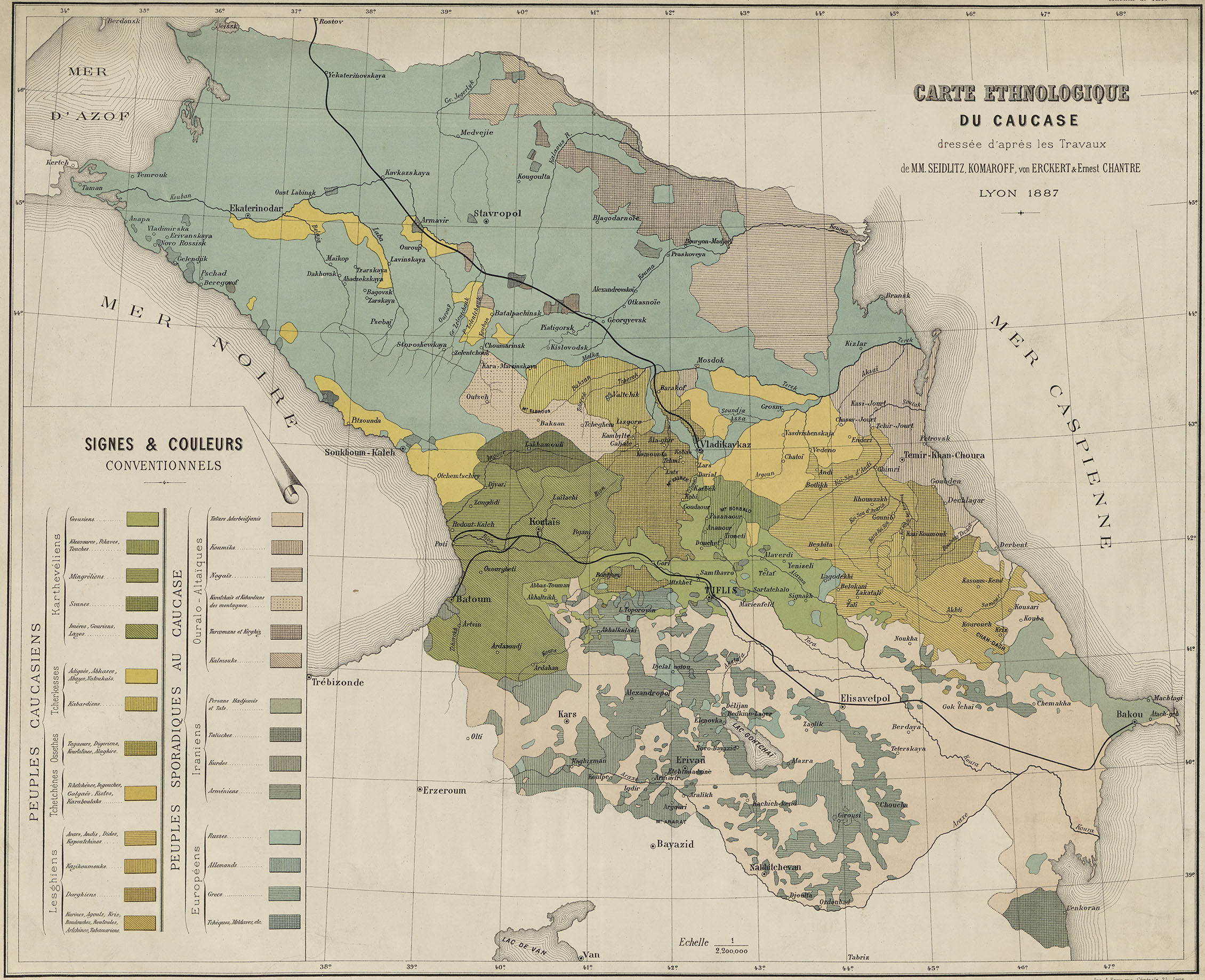
The Carte ethnologique du Caucase of 1887 is a remarkable synthesis of late‑nineteenth‑century scholarship on one of the most linguistically and culturally intricate regions of the world. Compiled from the works of Friedrich von Seidlitz, Nikolai Komarov, Friedrich von Erckert, and Ernest Chantre, four of the most influential ethnographers and geographers working on the Caucasus, the map reflects both the scientific ambitions and the political sensitivities of its time. It offers a rare visual attempt to classify, organize, and render legible the extraordinary mosaic of peoples inhabiting the mountain chains and lowland corridors between the Black and Caspian Seas.
By the 1880s, the Caucasus had become a focal point of imperial ethnographic inquiry. Following decades of Russian expansion, administrators, military officers, and scholars sought to understand the region’s complex human landscape in order to govern it more effectively. The authors whose work underpins this map were central to that effort. Von Erckert’s meticulous linguistic and ethnographic surveys, Seidlitz’s demographic analyses, Komarov’s regional studies, and Chantre’s anthropological expeditions all contributed to a growing corpus of knowledge that attempted to categorize the region’s populations according to language, religion, and perceived cultural affinities.
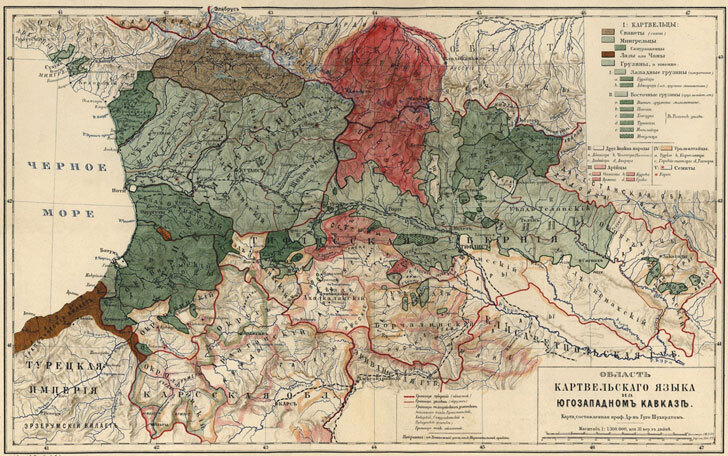
The map captures this classificatory impulse with striking clarity. It delineates the distribution of Armenians, Georgians, Ossetians, Chechens, Avars, Lezgins, Tatars (Azerbaijanis), and numerous smaller groups whose identities were often localized to a single valley or highland district. The resulting cartography reveals not a set of neatly bounded territories but a dense patchwork of overlapping communities, each shaped by centuries of migration, intermarriage, and shifting political allegiances. In doing so, it underscores the limits of any attempt to impose rigid ethnographic categories on a region defined by fluidity and contact.
At the same time, the map reflects the intellectual frameworks of its era. Nineteenth‑century ethnography often sought to classify peoples into stable “types,” and the Caucasus, long romanticized as a frontier of ancient tribes and heroic mountaineers, was particularly susceptible to such interpretations. While the map provides invaluable historical insight, it also invites reflection on how scientific cartography can both illuminate and simplify the realities it seeks to represent.
Today, the Carte ethnologique du Caucase stands as a key document for understanding how European and Russian scholars perceived the region in the late imperial period. It offers not only a snapshot of ethnographic knowledge in 1887 but also a window into the broader processes through which empires studied, mapped, and imagined the peoples they governed.