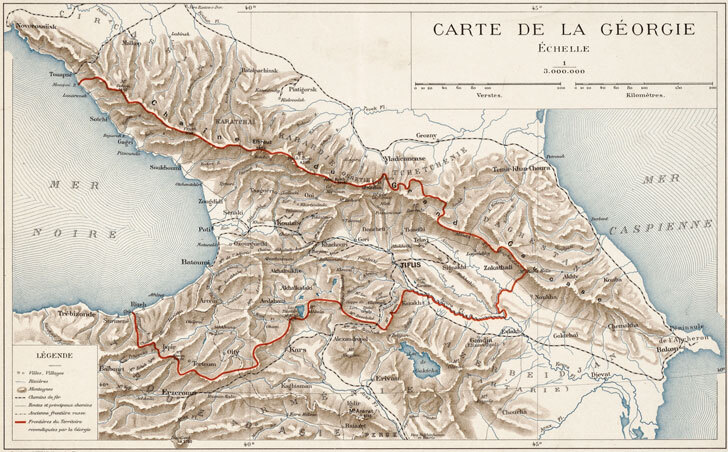
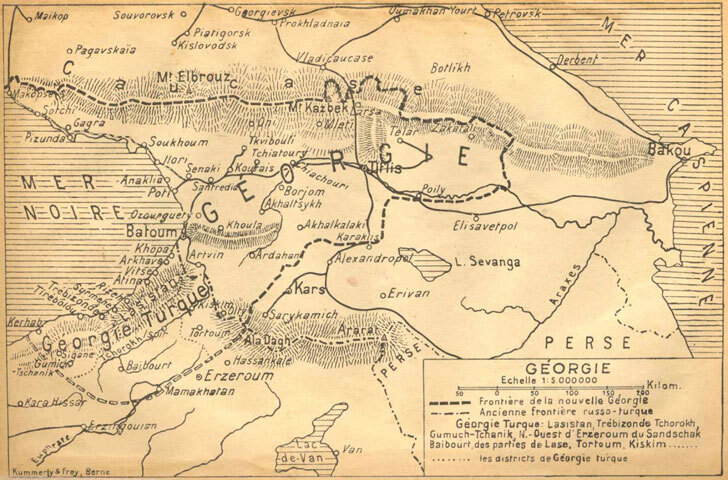
Source: Map of the Transcaucasian Socialist Federative Soviet Republic, Moscow, MID, 1932.
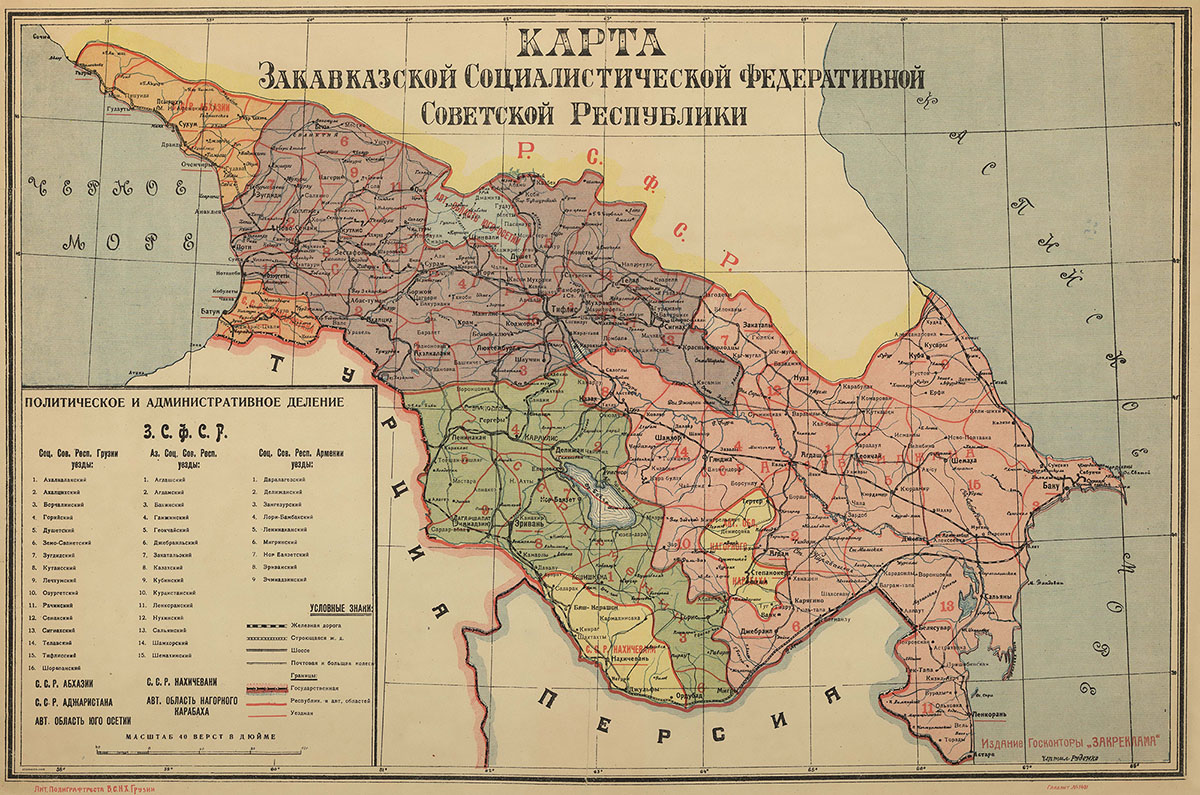
In 1932, the Transcaucasian Socialist Federative Soviet Republic (TSFSR) represented a distinctive political and administrative formation within the early Soviet Union. Established on 12 March 1922 and lasting until 5 December 1936, the TSFSR united the Armenian, Azerbaijani, and Georgian Soviet Socialist Republics into a single federative republic with its capital in Tbilisi. As one of the four founding members of the USSR, the federation was conceived to consolidate Bolshevik authority in a region marked by recent conflict, fragile borders, and exceptional ethnolinguistic diversity. It also served broader strategic aims: ensuring economic coordination, securing the southern frontier, and stabilizing a corridor linking the Black Sea, the Caspian basin, and the Middle East.
Politically, the TSFSR embodied the early Soviet tension between federalism and centralization. While Armenia, Azerbaijan, and Georgia retained republican institutions, their autonomy was framed within a federative structure that itself remained subordinate to the central organs of the USSR. By 1932, the consolidation of Stalinist rule had intensified this dynamic. Collectivization, the expansion of state planning, and the restructuring of local administrations all contributed to a deeper integration of the Transcaucasus into the Soviet political system. The TSFSR thus functioned both as a regional intermediary and as a mechanism for limiting the independent political trajectories of its constituent republics.
Administratively, the federation encompassed three union republics, each subdivided into oblasts and raions shaped by the national delimitation policies of the 1920s. Within Georgia, autonomous entities such as Abkhazia, Adjara, and South Ossetia reflected the Soviet approach to managing national minorities within a socialist framework. In Azerbaijan, the autonomous status of Nakhichevan and Nagorno‑Karabakh emerged from similar considerations. These arrangements were intended to balance ethnic recognition with the imperatives of centralized governance, though they often reflected political compromise as much as ethnographic reality.
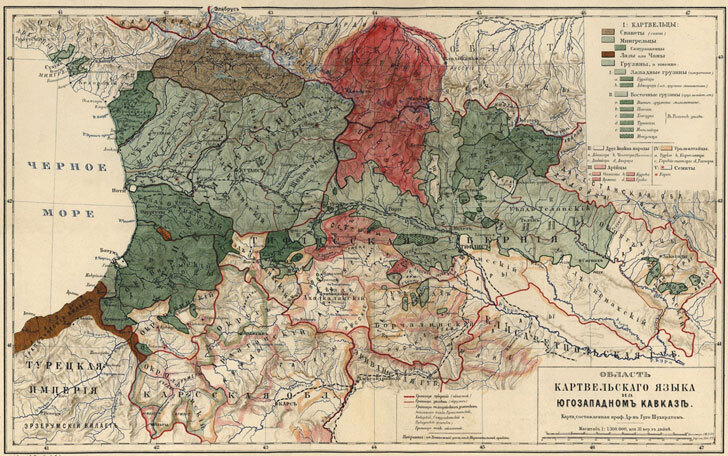
Ethnographically, the region remained one of the most diverse in the USSR. Armenians, Azerbaijanis, and Georgians formed the largest national groups, but they coexisted with Kurds, Lezgins, Avars, Ossetians, Russians, Greeks, and numerous smaller communities. Soviet censuses and linguistic classifications attempted to impose order on this mosaic, embedding ethnographic categories into administrative practice. Yet the lived patterns of settlement, intermixed villages, shared economic zones, and long histories of mobility, resisted rigid definition.
By 1932, the TSFSR stood as a complex political experiment: a federation designed to stabilize a volatile region, manage its diversity, and integrate it into the emerging Soviet order. Though dissolved in 1936, its administrative and ethnographic legacies would continue to shape the Caucasus well into the twentieth century.