The Persian delegation at the 1919 Paris Peace Conference presented ambitious territorial claims aimed at restoring Persia's territorial integrity and redressing what it viewed as historical injustices. These demands came at a time when the Persian state was weakened after decades of foreign pressure, particularly from Russia and Britain.
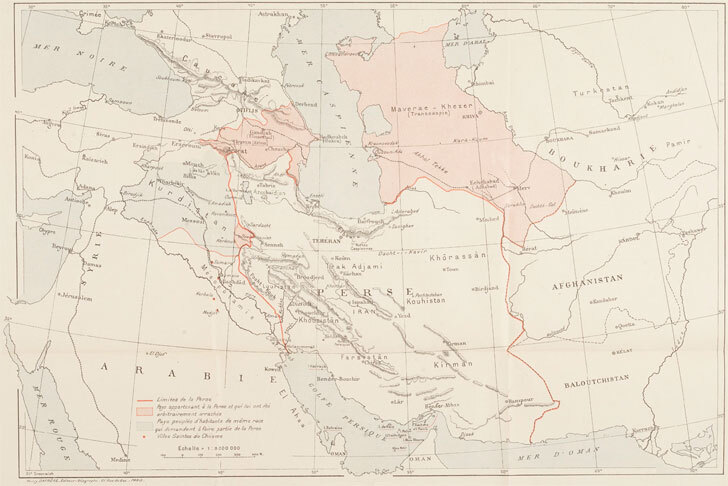
Persia, represented by a delegation led by figures such as Moshaver ol-Mamalek, primarily sought to recover territories lost during the nineteenth century. The claims focused notably on the South Caucasus, including regions like Karabakh, eastern Armenia, and Georgia—territories ceded to Russia through the Treaties of Gulistan (1813) and Turkmenchay (1828). These agreements, signed under duress following military defeats, were considered by Persians as unequal treaties imposed by an imperialist power.
The Persian delegation also demanded the restitution of territories in Central Asia, particularly regions of present-day Turkmenistan and Uzbekistan, which had been progressively absorbed by the Russian Empire during the second half of the nineteenth century. These claims rested on historical, cultural, and linguistic arguments, emphasizing the ancient ties between these territories and Persian civilization.
On the western front, Persia sought border adjustments with the Ottoman Empire, particularly in Kurdish and Azerbaijani regions where boundaries remained unclear. The delegation insisted on the need to protect Persian-speaking and Shia populations in these areas.
Persia also invoked the principle of self-determination, popularized by American President Woodrow Wilson in his Fourteen Points. Persian delegates argued that their country, having maintained neutrality during World War I despite foreign occupations, deserved special consideration and respect for its sovereignty.
Unfortunately for Persia, these claims remained largely unheeded. The great powers, preoccupied with their own geopolitical interests and the redrawing of the Middle East, paid limited attention to Persian demands. Britain and Russia, despite revolutionary upheavals in the latter, retained major strategic interests in Persia. Moreover, Persia's diplomatic and military weakness significantly limited its ability to impose its views.
This Paris experience helped strengthen nationalist sentiment in Persia and fueled frustration with the Western-dominated international order—sentiments that would play a role in the country's subsequent political transformations.